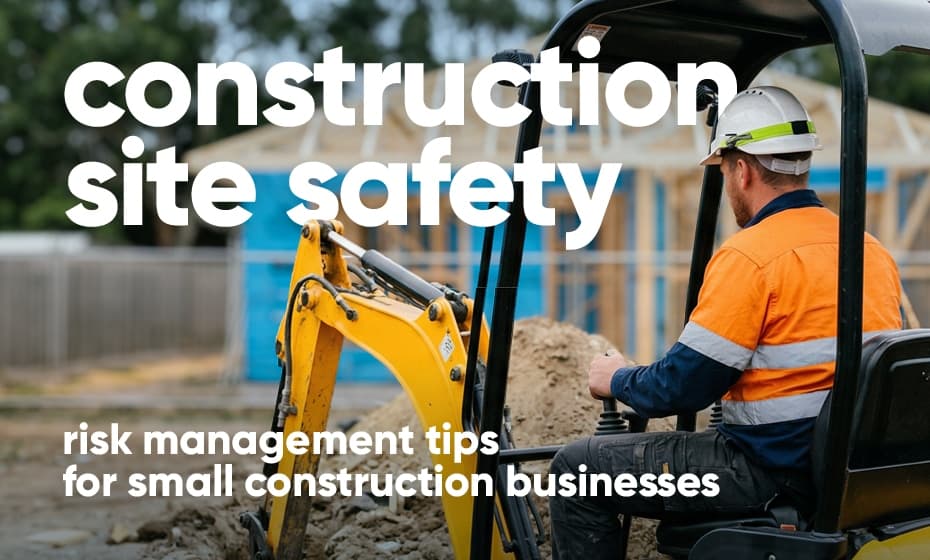
Did you know that the construction industry remains one of the highest-risk sectors in Australia? Since 2006, it has consistently ranked as one of the most hazardous sectors, with the fifth highest incidence rate of serious claims across all industries. For small construction business owners, maintaining strong construction site safety and effective construction risk management is essential for protecting workers and keeping projects running smoothly.
This World Day for Safety and Health at Work serves as a critical reminder for trade business owners in the construction industry to prioritise workplace safety and health. The global initiative highlights the importance of raising awareness about the prevention of occupational accidents and diseases (UN, 2025), emphasising the need for proactive measures to protect your workers and your business.
What are the Most Common Construction Sites Hazards?
The construction industry is fraught with risks, both physical and psychosocial. Navigating these challenges is further complicated by regulatory updates, high labour turnover, and the financial strain of managing workplace incidents. The operational impact of accidents, downtime, compensation claims, and reputational damage, can be devastating for small businesses.
For trades and business owners, the question becomes: how can these risks be effectively managed to ensure a safer and more sustainable work environment?
Practical Tips for Work Health and Safety
Conduct Regular Construction Risk Assessments
The most common causes of work-related injuries include being hit by an object (31%), manual tasks (30%), and falls from height (15%) (Safe Work Australia, 2021). These incidents often stem from physical hazards, however there are now rising psychosocial risks that are increasingly recognised as significant contributors to workplace injuries and illnesses.
Identifying potential hazards on-site, whether physical, chemical, biological, or psychosocial, is essential to creating a safer environment for workers. This allows business owners to implement effective measures to mitigate them, reducing the chances of accidents and injuries. These assessments should not be a one-off activity; they must be revisited and updated regularly to account for changes in work conditions, equipment, or personnel.
Invest in Safety Training
Safety training is critical to ensuring employees are equipped with the knowledge and skills to perform their tasks safely. In a survey, 39% of construction employers did not provide any WHS training to their employees (Loosemore & Malouf, 2019).
Comprehensive training should cover workplace safety protocols, the proper use of tools and machinery, and emergency response procedures. By investing in safety training, you not only protect your team but also reduce the likelihood of incidents that could lead to costly claims. IMAR’s insurance solutions are designed to support businesses that prioritise safety.
Proper Use of PPE on Construction Sites & Establish Safety Protocols
Providing high-quality personal protective equipment (PPE) is essential. Helmets, gloves, goggles, and harnesses should be regularly inspected and replaced when necessary. Educate your team on the importance of using PPE correctly to minimise risks.
Clear safety procedures and emergency response plans are vital. Ensure your team knows how to handle high-risk tasks and respond to emergencies. Regular drills can help reinforce these protocols and prepare your team for unexpected situations.
Mitigate with Risk-Led Insurance Solutions
Workplace safety is not just about compliance. It’s about protecting your team, your business, and your reputation. Even with strong construction site safety procedures, unexpected incidents can still occur. This is why many trades businesses rely on construction and public liability insurance to protect against claims, project delays, and financial loss.
For over 35 years, we’ve suppo rted hundreds of trades and businesses across Australia, helping them navigate risks and focus on what they do best.
At IMAR, we’re here to help you identify and mitigate risks, ensuring compliance with workplace safety regulations. Whether it’s public liability insurance, tools and equipment coverage, or income protection, imar is trusted all-in-one hub for tailored insurance solutions.
Call the imar team today on 13 IMAR (that’s 13 46 27), or submit a form to handle all your cover in one go.
References:
International Labour Organization (ILO). (2025). World Day for Safety and Health at Work. United Nations. Retrieved from https://www.un.org/en/observances/work-safety-day
Loosemore, M., & Malouf, N. (2019). Safety training and positive safety attitude formation in the Australian construction industry. Safety Science, 113, 233–243. https://doi.org/10.1016/j.ssci.2018.11.029
Safe Work Australia. (2021). Work health and safety perceptions: Construction industry. Retrieved from https://www.safeworkaustralia.gov.au/system/files/documents/1702/brief-perceptions-construction-industry.pdf